

Journal→What a Designer Notices in Every Hotel She Visits
What a Designer Notices in Every Hotel She Visits
By Savannah Dodge · May 13, 2026 · 8 min read
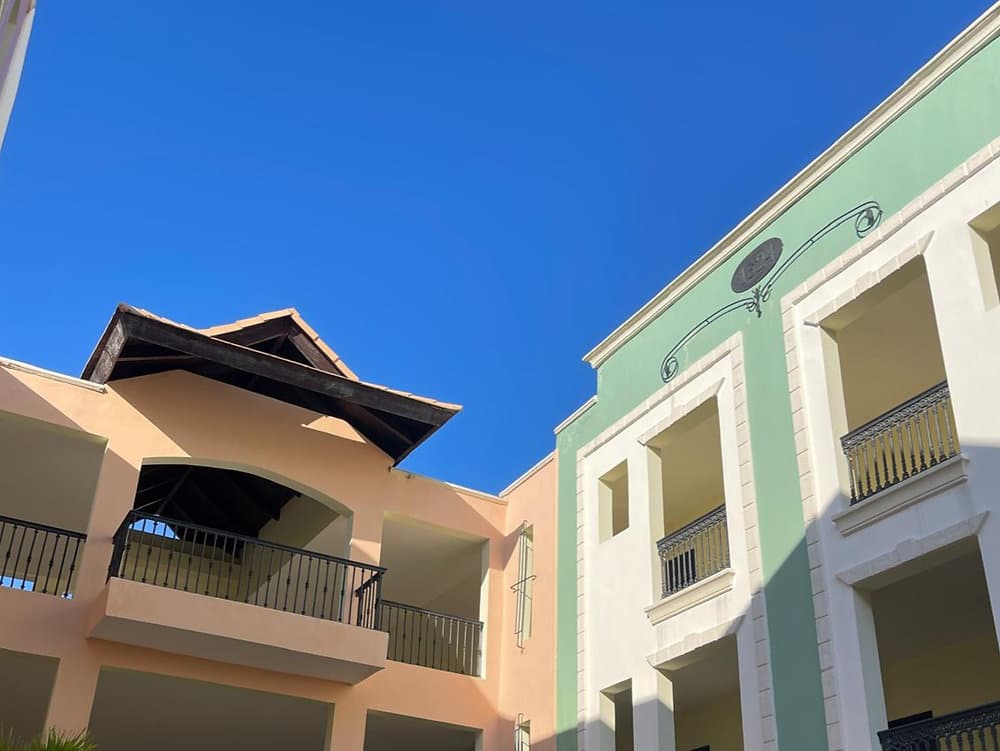
As I write this, I'm sitting in the indoor/outdoor mezzanine of a resort in the Dominican Republic. It's that slim window between the madness of check-in and the first wave of dinner cocktail hour -- the hour where the staff quietly shuttles in kegs and resets the space after a full day of guests. I'm alone in the middle of it all, on a bamboo-framed sofa with tweed upholstery, feeling a late afternoon breeze move through a space that is the perfect combination of indoor comfort and outdoor connection. My favorite combination in design, and in life.
Being an interior designer means I never fully turn it off. Every space I enter becomes a study -- what's working, what isn't, what decision someone made that I can feel even if I can't immediately name it. Traveling accelerates that. New climates, new cultures, new ways of solving the same fundamental human problems: how do we make people feel welcome, comfortable, at ease, and alive in a space that isn't their home?
Hospitality design is one of the most demanding and rewarding categories of this work. The approach shares DNA with residential design -- people are still sleeping, eating, gathering, and moving through space -- but the ephemeral nature of a hotel stay changes everything. A guest doesn't have weeks to settle into a space and learn its rhythms. The design has to do its work immediately, intuitively, and completely. There is no adjustment period. Either the space holds you from the moment you arrive, or it doesn't.
These are the elements I'm looking at.
Indoor/Outdoor Living
The single greatest asset of designing in a temperate climate is the relationship between inside and out, and the best hospitality projects treat that threshold as the most valuable square footage on the property.
Most of us spend our daily lives under artificial light, in front of screens, inside buildings designed for efficiency rather than experience. What makes a tropical resort feel restorative isn't just the sun or the water -- it's the sustained, uninterrupted access to fresh air, natural light, and the particular kind of groundedness that comes from being physically connected to the landscape. Barefoot on grass. Salt air moving through an open structure. A simple pull-down screen as the only barrier between you and the palm trees.
The mezzanine I'm sitting in right now understands this completely. No windows to fight with, no doors creating psychological separation between the interior and the world outside. Just a structure that holds space while the environment moves freely through it. That is not an accident. It is a design decision made at the earliest stage of the project, and it is the reason this space feels the way it does.
Layered Lighting
There is not a recessed can in sight, and the space is better for it.
Layered basket pendants, oversized sconces, low ambient sources that create warmth rather than visibility -- this is lighting designed to produce a feeling rather than illuminate a room. Hospitality lighting done well mimics the quality of natural light at its most flattering: diffuse, warm, directional without being harsh.
The instinct to reach for recessed cans is understandable. They're clean, they're flexible, they disappear into the ceiling. But they also flatten a space and drain it of atmosphere, which is the one thing a hotel cannot afford to lose. Guests should feel the lighting before they notice it. When you notice it, something has gone wrong.
Local Materials and Texture
Being on an island concentrates the material palette in a way that feels both practical and intentional. What's available locally, what survives the climate, what belongs to this place -- those constraints produce some of the most distinctive and resonant design decisions a project can make.
This hotel has leaned heavily into tile, and it's exactly right. Tile is the material language of the Caribbean -- colorful, durable, expressive, and deeply rooted in the craft traditions of the region. Used well, it does multiple things at once: it honors local artisanship, it handles humidity without complaint, and it gives the space a visual and tactile identity that couldn't exist anywhere else.
Beyond tile, the tactile experience of a space shifts entirely in a tropical climate. Rattan, bamboo, woven textiles, raw wood -- materials that breathe, that age honestly, that feel appropriate to their environment rather than imported from somewhere else. The best hospitality design in any region asks: what does this place want to be made of? The answer is almost always something that grew or was made nearby.
Space Planning and Privacy Within Public Space
The essence of space planning is assembling the pieces of a program so that everything works together like a complex puzzle. In hospitality, that puzzle has more pieces than almost any other building type: guest rooms, restaurants, bars, pools, spa facilities, arrival sequences, service corridors, accessible routes, staff circulation. The guest should experience none of the complexity. They should only experience the ease.
What separates exceptional hospitality space planning from adequate space planning is how it handles the relationship between public and private. A great resort creates moments of genuine intimacy within shared spaces -- the sense that you have a corner of the place to yourself even when the property is at full capacity. This is achieved through scale, through materiality, through the careful placement of seating that creates enclosure without walls. A sofa turned slightly away from the main circulation path. A canopy that defines a zone without closing it off. A cluster of lounge chairs positioned toward the landscape rather than toward each other.
The transitions matter too. How do you move from your room to the restaurant? From the beach to the lobby? The sequence should feel intuitive enough that you never consult a map twice, and experiential enough that the journey itself is part of what you're paying for.
Wayfinding and Arrival Sequence
The arrival experience sets everything that follows. Guests form their first and most durable impression of a property in the first ten minutes -- before they reach their room, before they eat, before they've settled into the rhythm of the place. That window is everything, and it is entirely designed.
Good wayfinding in hospitality is invisible. You move from the entry to the check-in to your room to the amenities without friction, without confusion, without the low-grade anxiety of not knowing where you are. This isn't achieved through signage alone -- it's achieved through sightlines, through the intuitive logic of how spaces connect, through moments of visual anchoring that orient you without demanding your attention.
The arrival sequence is a form of choreography. Where does the car stop? What do you see first when you step out? What draws you forward? The best properties script this deliberately, using landscape, light, sound, and spatial compression and release to create a sense of arrival that feels like the beginning of something rather than the end of a journey. When it works, you don't know it worked. You just feel immediately, inexplicably at ease.
Acoustics
This is the element most frequently overlooked in hospitality design, and the one whose absence is most immediately felt.
Sound behaves differently in open-air structures, in high-ceilinged lobbies, in restaurants designed more for visual impact than acoustic comfort. A space that looks beautiful in photographs can feel exhausting to inhabit if the acoustics haven't been considered -- too much hard surface, too much reflective material, too little absorption. Conversations compete. Music bleeds between zones. The ambient noise level climbs steadily through the evening until everyone is slightly more tired than they should be and no one can identify why.
The best hospitality environments layer acoustic absorption into the design without making it visible or clinical. Woven textiles, upholstered surfaces, plants, water features that mask rather than add to the noise floor, strategic use of soft goods throughout public spaces. The goal is a soundscape that feels alive without feeling loud -- one that holds conversation, supports atmosphere, and allows a person sitting alone on a bamboo sofa in the middle of the afternoon to feel the quiet even when the space around them is beginning to fill.
Hospitality design is, at its core, the design of a feeling. Every decision made in the planning of a hotel -- the orientation of the building, the material of the floor, the height of the ceiling, the path from the lobby to the pool -- is a decision about how a human being will feel when they move through that space for the first time. That is a profound responsibility, and one I find endlessly fascinating.
The standards set by the best hospitality projects are ones I bring back into every residential project I work on. Because the questions are the same: How does this space hold you? What does it ask of you? What does it give back?
If you're developing a hospitality or commercial project in the Hudson Valley and looking for a design partner who thinks at this level, I'd love to hear about it.
Love, Sav
Let's Chat!

From the Studio
Savannah Dodge
Savannah Dodge is the Chief Executive Officer and Principal Designer of Curio Studio. She earned her BFA in Interior Design from the New England School of Art & Design at Suffolk University and brings over a decade of experience designing thoughtful, layered homes.
More about the studioMore from the journal

March 3, 2026
The Women Who Inspire Me
On Curiosity, Voice, and the Architecture of Becoming Women’s History Month invites reflection. Not only on progress. N…
Read →
January 16, 2026
Why We’re Afraid of Color in Our Homes
Over the last ten to twenty years, our visual world has been quietly whitewashed. We moved from grey boxes to white boxe…
Read →
January 11, 2026
The Interiors of Happiness: Why We’re Drawn to Certain Aesthetics
What is it that makes us desire certain aesthetics? Our aesthetic preferences are not random. They mirror how we choose…
Read →